
 Muhammad Umair Khan
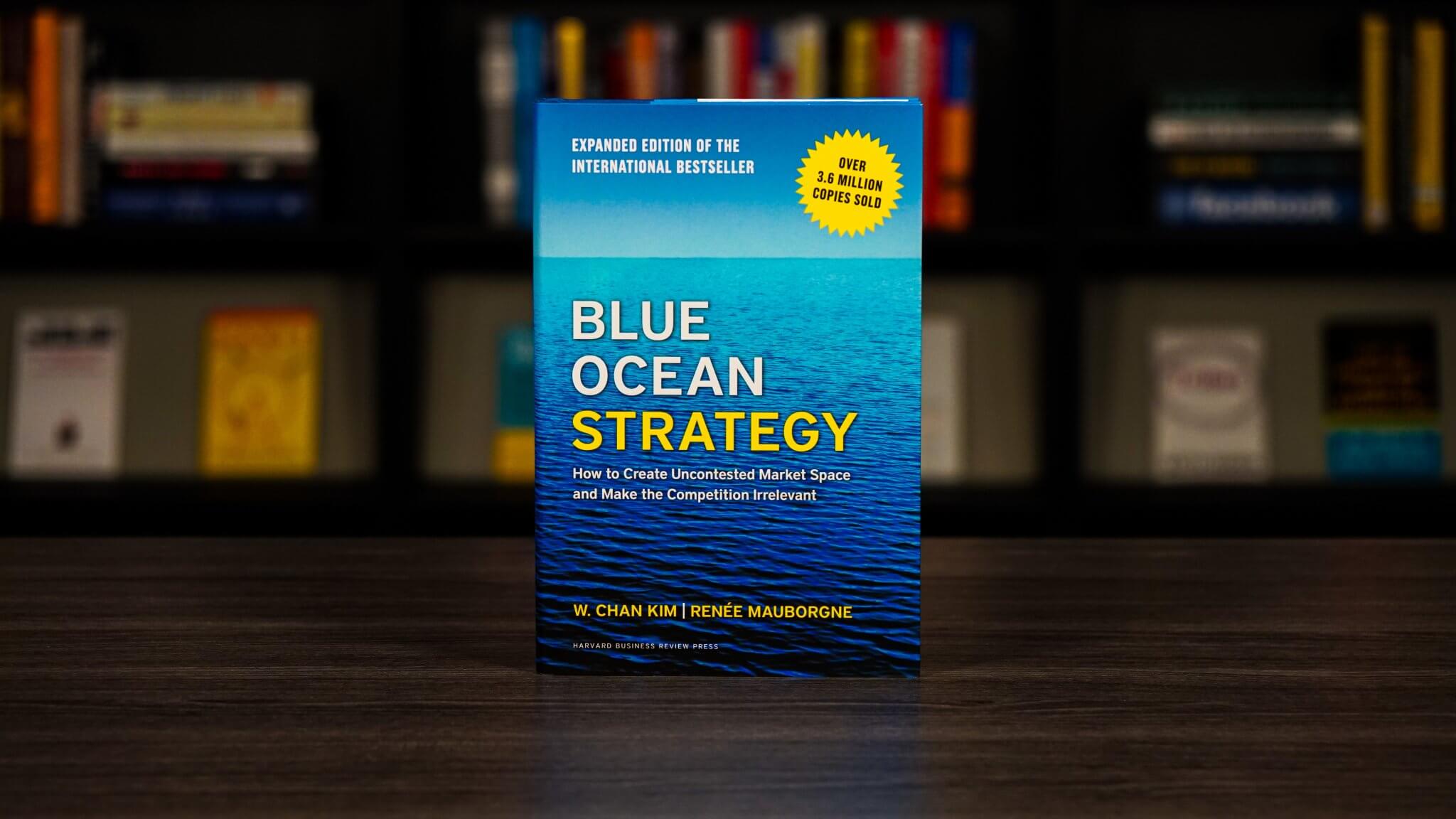
Blue Ocean Strategy is a masterpiece in defining how strategies drive success today. Companies adopt conventional strategies that seek to blow other competitors out of the water. The result, however, is far from what one might imagine. It is like beating a dead horse!
The book illustrates many ways through which an organization can rise above the pettiness of competition.
Some important things you will learn in this book are :
- Why Organizations should pursue value innovation.
- Why there should be an attempt to create and sustain new demand in the market?
- How competition is irrelevant.
- Why it is important never to lose sight of the bigger picture?
Quest For Uncontested Market Space For Grounding Blue Ocean Strategy
Most Companies focus on the consumers they target. And the competitors they fight with. However, creating new value for customers, or creating new customers, is the aim of a “Blue Ocean Strategy”. While value-creation and innovation is the need of the hour. It is therefore, a technology-driven, market-oriented, and futuristic market space does not allow companies to become inconsistent.
Companies need to continually work on their strategies. So as to stay alive and thrive in the market. They should deliver products and services that can create new value for consumers. Hence creating an uncontested market. This untapped market loaded with potential is an ocean enriched with new possibilities.
Not Subscribed Yet?
Do it now so that you are always updated with our latest posts and news.
In contrast, a “Red Ocean” refers to an existing market. And companies trying to beat the existing competition and cater to existing demand would swim in the red ocean. As markets get crowded, opportunities for growth and profits reduce. Consequently, firms compete with one another to sell similar products. And that results in perfect competition. In such a marketplace, companies command more or less the same price, with no one particular major player in the market. In the end, the demand for each firm gets distributed.
Value Innovation By Creating An Uncontested Market Space
A Blue Ocean can be for you to swim in if you can create value innovation. While we are familiar with innovation, value innovation doesn’t create something new. Instead, it improves on existing products or services, while reducing the overall costs for both the customer and the company. Thus, resulting in a tremendous leap in the offering’s value.

The Blue Ocean Strategy aims to break the value-cost trade-off by pursuing differentiation and low cost simultaneously. As compared to conventional strategies that pursue a value-cost trade-off, wherein it is this or that scenario. To embark on the path of value innovation, one must ask four questions in the product’s context or service:
- Which features can one do away with?
- What features can one dial down a little?
- Which features can one improve?
- What new features can one offer?
This is famous as the ERRC framework: Eliminate, Reduce, Raise, and Create. This framework can help achieve a unique value curve. Which creates a blue ocean of uncontested space!
Reimagine To Reconstruct Is Merely A Fence
Why is it necessary to reconstruct boundaries? Because, in order to create an uncontested market, a product or a service should seek to reconstruct the boundaries themselves.
There is a six-path framework to achieve this, as advised in the book:
Six Path Framework In Blue Ocean Strategy
- Look across alternates: Which industries serve the same purpose as your industry, but have a unique form? For example, restaurants may compete with movie halls indirectly. Since both fulfill the same utility for the customer, i.e., having a good time out.
- Look across strategic groups: Are there any untapped areas that the industry is not targeting? We typically rank strategic groups in a hierarchy with price and performance as parameters. What will make the customers trade up the value chain to pay a higher price? And what will make them trade down?
- Look across the Buyers: Who is buying? Is there a chain involved? Who are the influencers, the purchasers, and the end-users? It can be extremely valuable information.
- Look across complementary products and services: Assess the context of the usage of your product or service. What is the user doing or thinking BEFORE using your product? And what are they doing or thinking WHILE they use your product? Further, what do they do AFTER they use your product? The magnitude of the usage can throw light on areas that may be pain points. And if your product can address those pain areas, you have a blue ocean for yourself.
- Look across functional and emotional appeal: Can you transform the functional appeal of your product or service to an emotional one, or vice versa?
- Look across time: find out and identify the trends of the future. Can you use these trends to the best of your advantage? If so, you could swim in a blue ocean. This is in severe contrast to having a reactive strategy. Where one REACTS to the changing times and trends. Rather than proactively pinching the business model, product, or service.
Focus On The Big Picture
In the busy schedule of day-to-day business, managers can easily forget the larger context of their firm’s objectives. As a result, managers can become overly focused on micromanaging, determining the best price, implementing target-based costing, or determining the best market strategy. These are the things that they overlook, like the utility of the product or something like customer service.
Types of economic utility that consumers derive from goods or services are form, time, place, and possession. Hence, “Utility” refers to the usefulness or value that a purchaser obtains in return for exchanging his or her money for a company’s goods or services. Here is why, companies seek to maximize customer satisfaction by addressing all of the four utility – or as many as possible.
Example Of Amazon
Amazon, one of the biggest e-commerce brands, is widely acclaimed for its customer service. Because, Amazon provides extensive training to its delivery drivers. Especially on how to deal with female customers. And consumer feedback is highly valuable to Amazon. No wonder why, this focus on its major service, i.e. delivery, has ensured its success in the market.
In management, the ability to see the larger picture is a vital leadership skill. So we say, a leader should have a broad range of vision and insight. A leader’s ability to lead arises from the depth of his knowledge. And so leaders look into the future. As a result, they perceive the future reality. They report this reality back with their clear and detailed vision.
Do You Know?
We have a YouTube where you can watch and learn a lot from our free video resources.

We have a Facebook Business page where you can follow and contact us.

Generating New Demand In The Market
Demand creation is an economic affair. Because it bridges the gap between what the consumers really want and what is available. Further, it is the allocation of limited resources among the buyers.
Changeover In Business Style Over The Years
Twenty years ago, producers would adopt a production-oriented strategy wherein businesses expect buyers to purchase whatever is available to them. However, with changing times and increasing competition, producers have had to adopt Holistic marketing strategies. Therefore, they need to take into account the needs and desires of their target audience. It is natural, however, it would create a red ocean here too. Every firm would be competing for the attention of the consumers.
A firm needs to find its blue ocean in this very approach. Because a buyer-oriented market mandates the focus to be on existing customers, but non-customers could also be a source of untapped potential!
Advanced Marketing Strategies Are Based On Emotions
It is a common observation that brands use feelings to appeal to customers. So comes emotional branding into play. Emotional Branding is a term in marketing communications. It implies a well-crafted technique to appeal to the basic emotions of the consumers. Scientific studies have proved that shared emotional connection between brands and the consumers influences their attention to the product. And this generates new demand.
Few Case Studies
Here we go with three case studies to clear above idea:
i) An Alcoholic Beverage Company In Australia
An alcoholic beverage company in Australia, specializing in wine-making, was in a plateau with its market penetration. The number of beer drinkers in their country was much larger than the wine drinkers. And people perceive wine drinkers as high society fat cats. The company concentrated on its research and development to come up with a beverage. The beverage that tasted somewhat like beer but was fermented with grapes. The drink they eventually came up became an overnight bestseller having its takers among the beer drinkers too.
ii) The Pug In The Hutch Ads In India
The Pug in the Hutch Ads in India five years ago brought widespread appreciation. Both for the telecommunications company and the breed’s popularity in India! We should use tactfully emotional branding in order to influence the collective perception of people.
iii) A Reputed Circus Company In Europe
A reputed circus company in Europe was packing up. It was finding it difficult to compete in this era of television, the internet, and social media. Because the use of animals in circuses was increasingly being looked at with disdain. Hence, keeping in mind the mentality of its consumers, the management of the circus company pulled out the animal acts. Instead, they replaced them abstract and spiritual musical dances- an offshoot of theatrics. Ultimately, this move ensured the survival of the Company and gradually started bringing in huge revenues. Now, which Company do you ask the one and only, Cirque Du Soleil!
Formulate A Decisive Blue Ocean Business strategy
A decisive strategy involves business and marketing strategies that are different and cost-effective. A clear and competitive business strategy has a long-lasting impact on organizational profit and revenue. Every organization plans a strategy by which it tries to achieve its goals. These could be like growth, expansion, or even retrenchment! Out of the box, organizations encourage thinking in management as they lead to rare business strategies.
Dell, a major player in the computer technology business, established itself in a short period on the grounds of its unique business model. When firms were catering to generalized customer demand in the market, Dell concentrated on individual demand, offering a customized product. Their inventory was stocked with goods to assemble rather than the final product itself. This allowed them the liberty to design each product as per individual demand and in the process ensured no obsolescence.
A strategic move by the business creates a new value curve to capitalize on. A value curve is a graphical representation of the primary products or services that bring value to the firm, i.e., profit. Some techniques to explain the creation of a new value curve involve working on branding and promotions of a product or service. They should use wisely mass media and social media marketing for this purpose. The marketing mix used should be in tune with the target audience’s reach.
What Research Says
Research proves that Brand promotion is of vital importance to any company. Branding is not just an exercise to foster trust amongst customers, but also to help firms maintain their share price and increase profits. In the Indian context, Nestlé’s branding and repositioning of Maggi is an outstanding illustration of this phenomenon. Maggi had for decades penetrated deep in the consumer psyche and established itself as ready to eat a product.
In 2015, a legal case was filed against Maggi alleging that the product was extremely unhealthy- it had illegal amounts of lead and MSG content. Soon sales started dwindling, and they took inventory off the shelves in the market. Nestle fought the case, and eventually successfully rebranded and relaunched the brand as a healthy ready-to-eat product. They marketed Maggi as “Tasty and Healthy” with vitamins and iron. The company added value to its product through strategic rebranding. They had a clear-cut and interesting tagline.
Execute the Blue Ocean Strategy Perfectly
Simply put, without perfect execution, the product of the Company is unlikely to succeed. Now, this seems to be obvious, but it is easily overlooked. The Company pursuing the Blue Ocean needs to be transparent with all its stakeholders. Often, employees and other important stakeholders are resistant to change. This is because they are not sensitized to the need for change. Such a scenario can result in disengagement and the subsequent impact on the organization’s ability to pursue the blue ocean.
The Company along with its business managers should be able to identify problem areas in execution and anticipate people who may oppose the plan. This information can be thus used for managing the execution in a better manner. Since the pursuit of a blue ocean requires constant value innovation, the process of execution is also a constant feature, and thus blue ocean businesses should aim at developing an organization that is friendly to change, in order to smoothen the challenges with execution.
Conclusion of Blue Ocean Strategy
An organization cannot simply function in the marketplace today, it has to sustain itself. Competition is fierce, and the stakes are at an all-time high. In an attempt to rise above the rest, organizations adopt a tunneled approach to outshine competitors.
Firms try to create both value and cost by adopting the conventional way of thinking in business, i.e., focusing on their competition, however, a new way of thinking that has proved to be more productive is digging deeper into the insights of the buyers. This approach has led to the formation of numerous new products and services.
The best strategies focus on individual action, not collective action. Along with designing effective strategies, firms also need to execute them brilliantly. This requires managers to be more inclusive and democratic with their employees.


