
 Muhammad Umair Khan
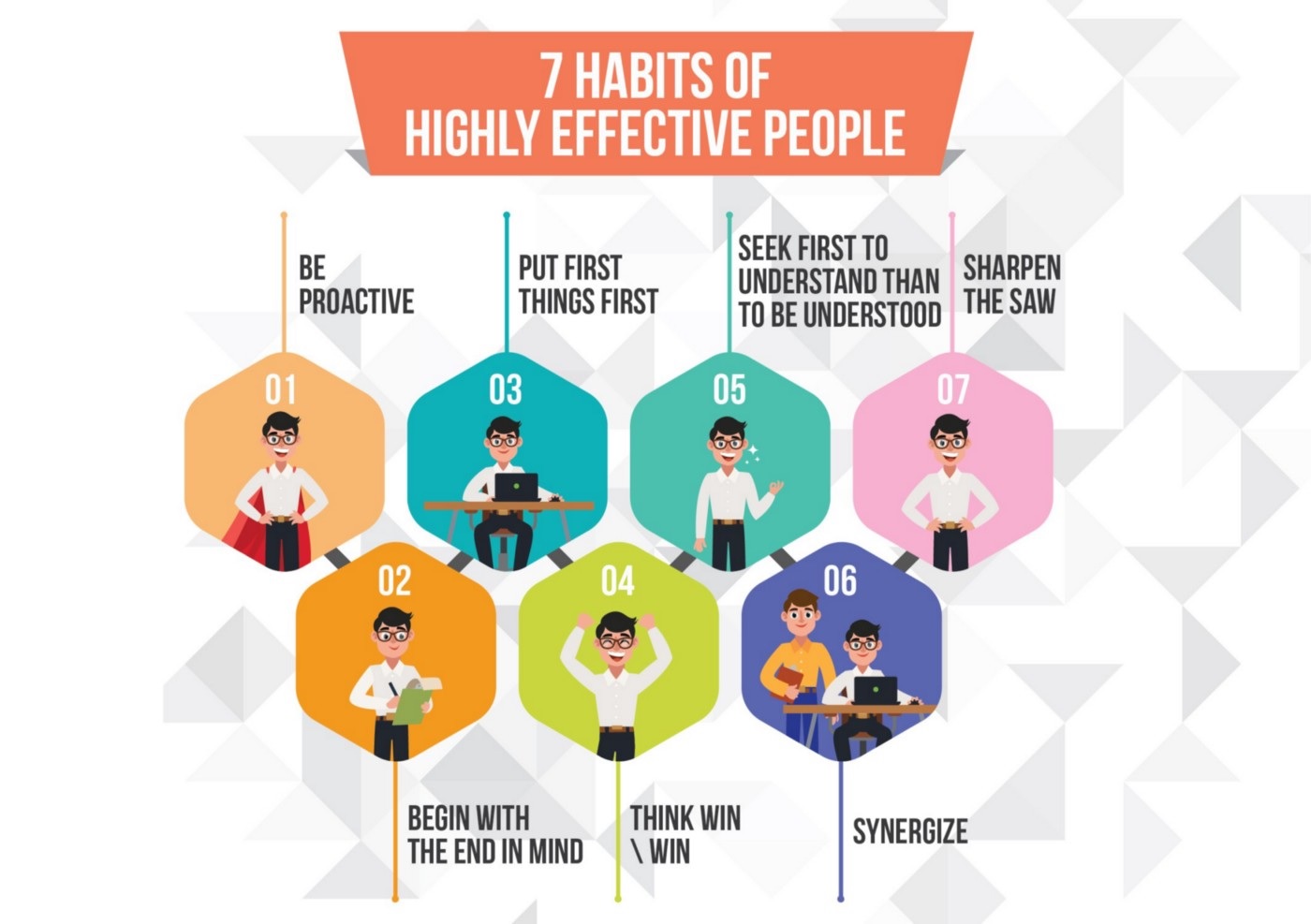
The Seven Habits of Highly Effective People is a masterpiece by Stephen R. Covey. He describes in this book the seven habits that are common in people with a high level of effectiveness.
You must have seen many people today who seek a step-by-step guide to success. They are indeed looking for a method that outlines a few steps to follow to achieve the success of your choice. Unfortunately, there is no such guide yet. The methods that are available recommend only temporary solutions to most generic problems. Admittedly, the problems that are holding you back from achieving something in the short run. However, there is no particular step-by-step guide to giving you a long-term solution and guaranteeing success.
This truth leads Stephen R. Covey to find a list of actions that are common in most successful people. Here we go with the summary:
PARADIGMS AND PRINCIPLES OF SEVEN HABITS BY STEPHEN R. COVEY
These seven habits are not basic principles to follow. Rather, these habits are a solid amalgam of various minor habits that constitute a positive and constructive attitude.
Moreover, these seven habits are not merely observations. Rather, they are formed on compact principles. If one master these principles, the resultant personality is highly effective. This book aims at the same principles by telling the ways to control your destiny by your own hand.
According to Covey, A principle-centric person is most likely to get to a level of high effectiveness. Provided, he is principle-centric in all aspects of his life.
Below are the seven habits, summarized separately for easy understanding.
Not Subscribed Yet?
Do it now so that you are always updated with our latest posts and news.
Habit 1: BE PROACTIVE
In your whole life, you come across many choices at your hand. Ultimately, it is your sense of choice which can make it a moment of advantage for you. Or, you may lose the opportunity. Indeed, a golden opportunity sometimes. And when the opportunity is gone, there is no guarantee that it will come again. Therefore, it is baseless to say that life is not under your control. You control your life by making a choice. Whether a correct choice or a wrong one.
Conclusively, it is only you who is responsible for your life. There is no one else who does it for you, but only you are the one to choose out of many options. The people who have put this thinking in their brain are said to be “Proactive“.
You must have seen many people blaming others for what happened in their life. Surely, they keep trying to justify by telling many reasons for whatever happened in their life. These kind of people are “Reactive” but not “Proactive“. You can either make your life awful, or you can make it pleasant. So, the choice is yours and only yours.
Likewise, you bear a great responsibility to choose what to speak. Simply because, anyone can judge whether you are proactive or not, only by hearing what you speak and how you speak. If you speak confidently with a crystal clear vision of your goals, you will certainly be judged as a Proactive. Similarly but negatively, if you keep complaining about your own life, you are definitely Reactive.
There are certainly many things in your life which no one can control but you. Being a proactive person, you will focus on these aspects only. And avoid uncontrollable aspects like political environment, weather, natural disasters, and the country’s economy.
Habit 2: BEGIN WITH THE END IN THE MIND
Vision requires focus. To maintain focus, you must not entertain the unseen future. Rather, you should focus only on the present. So, live the moment you are in. But remember not to forget the ultimate goal you dreamed of. It sounds hard, but it is much easier to live in one moment at a time. You can do it by tackling the situation at hand and then moving on.
Keeping the goal in focus is the key to tackling the present situations efficiently. Since, without a goal, life is meaningless. So, first, decide the goal you are going to achieve and then visualize it. This gives you a clear vision of what you would likely be achieving after tackling the present situation successfully.
Thanks to Almighty Allah who has blessed us with a brain that can imagine. You simply, need to use the imagination power of your brain and start visualizing your future. Ultimately, the visualization accelerates the process of achieving your goal. Because, things keep happening twice, once in your mind and once in the physical world. By not visualizing your goal, you are handing over your life to the happenings around you. The happenings which are out of your control. So, keep your life in your hand by finalizing your life’s goal in your mind.
One advice from the corporate way of working: Develop a mission statement for your life. This will help you focus more on your goal and will help you turn your dream into reality.
Do You Know?
We have a YouTube where you can watch and learn a lot from our free video resources.

We have a Facebook Business page where you can follow and contact us.

Habit 3: PUT FIRST THINGS FIRST
Once you have done with imagination, not it is the time to go physical. Consequently, start implementing practically what you have imagined before. Most importantly, this habit tests your ability to manage yourself. That is, how you manage yourself in a physical world determines to which extent you turn your dreams into reality.
The people who set priorities are more prone to managing themselves successfully. So, you first need to set priorities of tasks and jobs to do and then concentrate on them based on their priority level. This approach keeps you moving towards your goal step-wise. And the good thing about it is, you keep knowing where you are standing at a particular time and how is your success rate going.
You may come across many distractions in between your priorities. But not to worry here, just avoid those distractions and say no wherever necessary. Simply, focus on the big picture, and your final goal, and keep going.
Time management plays a vital role in achieving any goal. I would recommend these four methods to follow for good time management:
Methods Of Time Management Stephen R. Covey Suggests Alongwith Seven Habits:
- Establish a to-do list and write down important notes.
- Use the calendar, to mark important dates (appointments, start date, due date, etc.)
- Make sure you complete the task by the due date and check it from the checklist
- Complete tasks in a series from most important to least important
I would suggest completing the most important task before it becomes too urgent. For me, this is the most effective technique to manage time. To manage time this way, follow these steps:
- Identify the different roles you play in the workplace or at home. For example, you may be a father, son, brother, colleague, boss, customer, supplier, etc. Once you decide role, enlist them in descending order of the duration of time you spend on each.
- Now, write down a couple of goals for each role that may be achieved in a week. These short-term goals are the building block of your long-term goal.
- Before a week start, plan your activities for the whole week. But, make sure to remember the best time of the day to do tasks. It may be night or day or evening. Find the best time you perform and plan your activities accordingly.
- Keep your weekly schedule in check daily. It is possible to find that certain tasks cannot be achieved. Perhaps, because of any sudden task or something unusual. So, schedule those tasks for a later time.
Stephen R. Covey shares a time management matrix for various types of tasks:

Habit 4: THINK WIN/WIN
A victory is really a victory if every party involved in it wins. And this happens only when you believe that life is not a game. Although it is common for our people to refer to life as a game, In a game, there is a win for one team and a defeat for another. You cannot become an effective human being if you treat life as a game. For it is a win-win mentality that allows you to be effective with those around you. If you lead to win for yourself and destroy others, you won’t be effective anymore.
How will you identify that a person is harmonious and bears a win-win mentality? Just look for these three qualities in that person. If these three qualities exist, the person is harmonious:
- The person is true to his feelings, responsibilities, and beliefs.
- The person never counters the opinions of others. Rather, he represents his own opinions boldly.
- He believes in the victory of everyone, not only himself.
This is the real sophistication that makes up such a person. And it is being cordial, tenacious, and compassionate simultaneously to achieve real sophistication.
Habit 5: SEEK FIRST TO UNDERSTAND, THEN TO BE UNDERSTOOD
While attempting to persuade, it is equally important to demonstrate understanding of what others say. Only speaking in a conversation doesn’t lead to a fruitful conclusion, listening is equally important. Because conversation is a two-way process. And this process completes itself when listening is given the same adequate place in the conversation as speaking. But remember the difference between hearing and listening. Listening involves active attention to the speaker.
Listening can be divided into four types:
- Total ignorance of everything the other person says.
- Just pretending you are listening.
- Listening to the other person, but not following his point of view to understand the same.
- Listening and understanding from another person’s perspective.
It is human nature that he wants others to listen to him. But, it is equally true that people listen to reply, not to understand. Contrarily, if still, people understand, they understand it from their own perspective. And not from the perspective of the speaker. Indeed, people understand from their own experiences and reply in various ways. Here are a few ways the people reply by:
- People judge you with their own experience and either they agree or disagree.
- Comparing your experience with theirs, they will either ask questions.
- They will suggest you for your problems.
- Based on their own experience, they will evaluate your actions.
Conclusively, listening is the key to understanding. If you listen to someone else, he would also be keen to understand. Ultimately, there would be the least conflicts amongst.
Habit 6: SYNERGIZE
Teamwork is the key to big achievements. You cannot achieve a big goal while working individually. Therefore, you have to work with other people in harmony for each other’s benefit. And when you work in a team, you learn surprising things about yourself that help you achieve more and even more quickly.
To work effectively in a team, everyone must be interested in the other members. This lets everyone learn new things over time and helps the entire team produce astonishing results.
The most admirable aspect of teamwork is the innovation derived from the individual experiences of many people. because everyone on the team is different and has certain experiences that others don’t. So is the reason for teamwork more interesting? Ultimately, with teamwork, an environment of shared experience is formed which helps achieve bigger goals in an easier way.
To make full use of teamwork, achieving the command over the first five habits out of seven habits are mandatory. The first five habits are: being proactive, visualizing, implementing in the physical world for goals, maintaining a win-win attitude, and understanding others.
If you imagine a world with all people alike, you will not be imagining any innovation. Being different is a strength and should not be treated as a weakness.
Habit 7: SHARPEN THE SAW – PRINCIPLES OF BALANCED SELF-RENEWAL
Physical, mental, emotional, and spiritual beings are a few dimensions of personal growth. While a person is busy practicing the first six habits, he should also be taking care of his personal growth. This will make a complete seven-habit scheme. You can work on these four dimensions for personal growth by engaging in the following practices:
- Keep the brain active by reading, writing, and planning production activities.
- Promote physical health by exercising and ingesting the necessary amount of nutrition every day.
- Empathize with others and help them whenever they are in need. This will keep your emotional factor at its just peak.
- Keep doing something good every day and meditate regularly. Both these activities boost your spiritual being.
In order to cultivate the first six habits, it is essential to take care of all four dimensions, which collectively ensure your personal growth. If you ever forget or omit any one of these four, you will face an unhealthy imbalance in your health. To stay balanced and focused in life, you must practice what it takes to ensure you keep practicing all four dimensions.
THE CONCLUSION OF SEVEN HABITS BY STEPHEN R. COVEY
Although these seven habits give clarity to individual activities. However, ‘Mastery Of Self’ is the common link between all these. To master oneself, the very first step is the transition from being dependent to independent. Because independent people do not work well in groups. And teamwork is a mandatory aspect of your life to achieve bigger goals or become an effective leader. As a result, the next step requires you to become interdependent. And being interdependent is the key to unlocking the doors to big achievements.
Considering you cannot change anyone else if you do not change yourself, it becomes adequately important to take care of yourself first. Focus on your physical, mental, emotional, and spiritual aspects of life and improve them.
The most touching line by Covey:
“The key is not to prioritize what’s on your schedule, but to schedule your priorities.”
Stephen R. Covey


✅ I still remember reading 7 Habits in college and feeling fired up—but also kinda overwhelmed by the structure 😅. It wasn’t until I explored the Archetype6 community (I’m a Seeker, apparently) that things started clicking in a more personal way.
Here’s what finally stuck for me thanks to that:
1. I now rotate focus between habits without losing progress—helps with Seeker brain.
2. I use curiosity as the cue, not rigid scheduling. That made everything more natural.
3. Having others with the same execution style reflect back what worked for them has been huge.
Anyone else wrestle with trying to “be proactive” but end up starting five new systems at once? Trying to learn how to channel energy without derailing momentum.